“You must never confuse faith that you will prevail in the end… with the discipline to confront the most brutal facts of your current reality.”
— Jim Collins, Good to Great

📚 Why Hard Conversations Matter
Hard conversations aren’t about power — they’re about professional clarity.
They hold individuals accountable while preserving the integrity of your leadership and school culture.
When we avoid them, we protect feelings but endanger outcomes.
🧠 Emotional Intelligence is the Engine
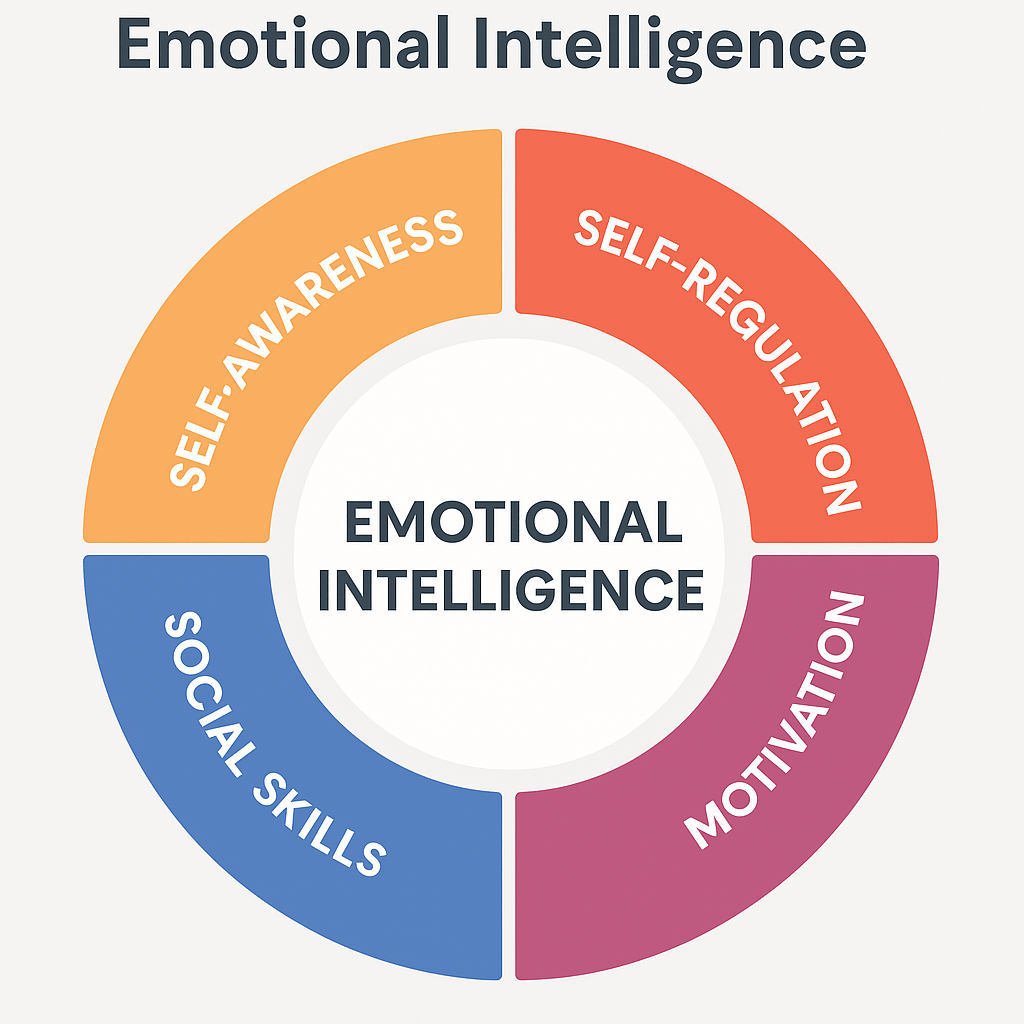
The 5 Core Competencies of Emotional Intelligence
(Goleman, 1998)
Each time we engage in a difficult conversation, we’re applying Emotional Intelligence to:
- Stay calm under pressure (Self-regulation)
- Speak truth without cruelty (Empathy)
- Maintain a mission-minded focus (Motivation)
⚖️ The 3 Fs Framework: Fair, Firm, Forward-Focused

“Facts over feelings. Accountability over avoidance.”
Three interlocking gears labeled:
- Fair → Evidence-based
- Firm → Boundaries + Consequences
- Forward-Focused → Solutions + Support
🔎 Scenario: The Copyright Policy Violation
📘 Context:
A teacher continues using unauthorized curriculum materials despite prior conversations.
Suggested Language:
“Mr. Daniels, I want to start by acknowledging your creativity. However, our policy requires all supplemental materials to be vetted…”
💬 Callout Box:
✅ Fact
✅ Past warnings
✅ Policy reference
✅ Collaborative invitation
✅ Documented next steps
🔨 Tools That Help You Lead Through It
💡 Use These Research-Backed Tools:
| Tool | Strategy | Source |
|---|---|---|
| Cognitive Reappraisal | Reframe challenge as opportunity | Gross (2002) |
| Learning Conversation Protocol | Balance feedback with growth | Stone, Patton & Heen (1999) |
| Crucial Conversations Model | Stay emotionally safe & direct | Patterson et al. (2002) |

📊 Flowchart: From Issue to Resolution
- Issue arises →
- Evidence gathered →
- Schedule conversation →
- Use 3 Fs Framework →
- Document →
- Follow-up & monitor

“Leadership begins not when it’s easy — but when it’s necessary.”
🔁 Closing the Loop: Always Follow Through
📌 Email summary
📌 Documentation in file
📌 Monitor behavior
📌 Provide supports (PD, coaching, mentoring)
“Greatness is not a function of circumstance. Greatness, it turns out, is largely a matter of conscious choice and discipline.”
— Jim Collins
📚 Sources Cited:
- Collins, J. (2001). Good to Great. HarperBusiness.
- Goleman, D. (1998). Working with Emotional Intelligence. Bantam Books.
- Stone, D., Patton, B., & Heen, S. (1999). Difficult Conversations. Penguin Books.
- Patterson, K., Grenny, J., McMillan, R., & Switzler, A. (2002). Crucial Conversations. McGraw-Hill.
- Gross, J.J. (2002). Emotion regulation. Psychophysiology, 39(3), 281–291.
 School Leaders' Think Tank
Leave a comment